

By analyzing the planetary positions at the time you are born, your birth chart can provide you with valuable insight about your life. However, it is important to know that while it provides valuable insights, it cannot address all areas of your life in the same way.
After all, one chart, with nine planets, spread across twelve houses, has the complicated job of answering questions about your career, relationships, family life, education, spirituality, and many more, all at once!
The ancient Vedic astrology scholars recognized this limitation and came up with a brilliant solution.
They divided each zodiac sign into smaller segments and created a specialized chart that focuses more closely on specific areas of life. These specialized charts are known as Divisional charts in astrology, or Varga charts.
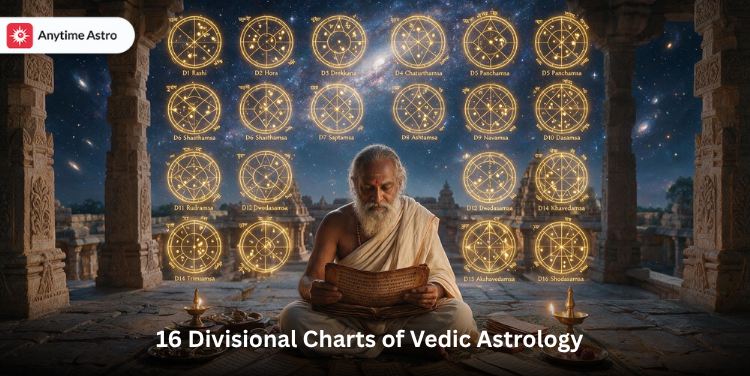
According to the Brihat Parashara Hora Shastra, the 16 major Vargas (Shodasha Varga) are among the most outstanding astrology systems. Divisional charts in Vedic astrology are considered one of the most sophisticated predictive methods, where each Varga chart functions like a microscope that offers more detailed insights into our lives.
Read on to learn about every major Varga chart from D1 - D60, what each of the 16 Divisional charts in astrology reveals, and how to read them.

What are Divisional Charts in Vedic Astrology?
Divisional charts are one of the most interesting and important parts of Vedic astrology that give deeper insights by breaking down each zodiac sign into specific parts or divisions.
Each zodiac sign spans 30 degrees, and each division concentrates on a specific aspect of life. It provides a more in-depth understanding than the traditional birth chart, which considers all 30 degrees of a sign equal.
If you find it confusing, let’s understand the Divisional charts meaning with an example. When you read a D9 Navamsa chart, each sign is divided into 9 parts, with each segment measuring 3 degrees and 20 minutes. This means that even though two planets share the same sign in the main chart, a planet at 14 degrees of Aries will be in a different Navamsa segment than a planet at 22 degrees of Aries.
This subtlety demonstrates how two people with the same zodiac sign placement, but varying degrees can display different divisional chart placements.
What makes the divisional system so lovely is its capacity to extract predictive information from the exact degree of each planet. This is something the main chart may miss, and this is why the divisional charts are so important for people who want a deeper astrological interpretation.
When it comes to precision, the higher the division number, the more precise the segmentation.
For instance, Shashtiamsa, or D60, splits every sign into 60 parts, each of which is only half a degree in size. This degree of accuracy means even a small minute difference in birth time could move a planet into a whole new Shashtiamsa. This sensitivity is what makes D60 one of the most powerful and insightful Divisional charts in astrology.
So, Divisional charts in Vedic astrology help us to understand our lives better by showing how different aspects of our personality and fate are interconnected.
There are 16 different types of Divisional charts in astrology that help us to gain in-depth predictions about the various aspects of the horoscope, such as marriage, relationships, finances, etc. So, let’s proceed to understand each one of these Varga charts in astrology from D1 to D60. But before that, let’s look at the Divisional table:
The 16 Main Divisional Charts in Vedic Astrology
The table below gives the complete list of Divisional charts in astrology, including the division of each chart and the specific areas of life that are associated with them, as given by traditional texts. This information helps you understand the influence of the divisions on the different aspects of your life.
|
Varga |
Varga Name |
Division |
Primary Area |
|
D-1 |
Rashi Chart |
30 degrees |
Overall life, physical body |
|
D-2 |
Hora Chart |
15 degrees |
Wealth and financial success |
|
D-3 |
Drekkana Chart |
10 degrees |
Courage, short trips, and siblings |
|
D-4 |
Chaturthamsha Chart |
7.5 degrees |
Wealth, real estate, and fixed assets |
|
D-7 |
Saptamsha Chart |
4.285 degrees |
Children, progeny |
|
D-9 |
Navamsha Chart |
3.33 degrees |
Dharma, marriage, and fortune |
|
D-10 |
Dashamsha Chart |
3 degrees |
Career, occupation, and status |
|
D-12 |
Dwadashamsha Chart |
2.5 degrees |
Parents and heritage |
|
D-16 |
Shodashamsha Chart |
1.875 degrees |
Vehicles, conveyances, comforts |
|
D-20 |
Vimshamsha Chart |
1.5 degrees |
Spiritual development, upasana |
|
D-24 |
Chaturvimshamsha Chart |
1.25 degrees |
Learning and education |
|
D-27 |
Saptavimsamsa Chart |
1.111 degrees |
Strengths, weaknesses |
|
D-30 |
Trimshamsha Chart |
1 degree |
Misfortunes, bad things |
|
D-40 |
Khavedamsha Chart |
0.75 degrees |
Inauspicious or auspicious effects |
|
D-45 |
Akshavedamsha Chart |
0.667 degrees |
General well-being |
|
D-60 |
Shashtiamsha Chart |
0.5 degrees |
Karma from Past life |
This table is a brief overview of the 16 Divisional charts in Vedic astrology. Let’s proceed to understand the in-depth overview of these astrology Divisional charts.
What are the Different Types of Divisional Charts in Astrology
Divisional charts are one of the most important parts of Vedic astrology that provide in-depth insight into various aspects of our life, such as our love life, career, finance, health, and more. You can also chat with best astrologer online and get their guidance about the Divisional charts in astrology and how the Divisional charts calculator works.
Let’s explore the 16 most commonly used astrology divisional charts and their significance in our lives.
1. D1 - Rashi Chart (The Foundation Chart)
The Rashi chart, also called the Lagna chart, is the fundamental chart in Vedic astrology. It shows the positions of nine planets, known as grahas, and twelve houses based on where they were at the time you were born.
This chart represents your ascendant, or lagna, which is the zodiac sign rising on the eastern horizon during your birth.
The D1 - Rashi Chart helps you understand different parts of your life and personality. It reveals your overall personality, how you think, your strengths and weaknesses, and the struggles you may face. It also provides insights about your family, career, and the obstacles you might encounter.
So, if you find using the Divisional charts calculator that you have a D1 - Rashi Chart, it can help you better understand yourself and your life journey through Vedic astrology.
2. D2 - Hora Chart (Financial and Wealth Capacity)
The D2 chart, also known as the Hora chart, helps us understand your money or financial matters.
The D2 - Hora Chart is a significant divisional chart in astrology that breaks down every zodiac sign into two parts of 15 degrees each. The planets are positioned in either the Moon Hora or the Sun Hora. The Sun Hora is about how you generate wealth and take control in the financial area, and the Moon Hora is about emotional security and nourishing your financial life.
By looking at the Hora chart, you can gain insights into your financial situation. It can show you your income sources, assets, and overall financial stability. The D2 - Hora Chart is useful for anyone wanting to improve their money matters or understand their relationship with finances better.

3. D3 - Drekkana Chart (Siblings and Courage)
This divisional chart in Vedic astrology is divided into twelve signs, and each sign has three segments of 10 degrees. This division is called the Drekkana chart, or Dreshkana.
This D3 - Drekkana Chart is important in classical Jyotish, especially because it relates to the third house. The third house connects to communication, courage, and relationships with siblings.
The Drekkana chart helps you understand your relationships with your siblings. It can also show your talents and abilities in different areas of life. By looking at the Drekkana chart, you can see the dynamics in your family relationships and recognize potential challenges or strengths.
Exploring this Divisional chart in astrology allows us to better understand your connections with siblings and helps in personal growth.
4. D4 - Chaturthamsa Chart (Fixed Assets and Property)
The D4 chart, also called the Chaturthamsa chart, divides each zodiac sign into four parts, each 7 degrees and 30 minutes long.
This D4 - Chaturthamsa Chart is important for understanding issues related to the 4th house, which focuses on home, family, and emotional health. By looking at the D4 chart, you can learn important things about your life, like your living situation, family property, and real estate issues.
Additionally, the D4 - Chaturthamsa Chart gives insight into your emotional security.
It helps you understand the value of family ties and your connection to inherited wealth. This chart helps you explore your roots and how they affect your current life. The D4 chart provides useful information to help you better understand family dynamics, improve your living situation, or consider your heritage.
5. D7 - Sapthamsa Chart (Children and Progeny)
The Saptamsa chart is an important divisional chart in Vedic astrology that focuses specifically on matters related to children and offspring.
In this D7 - Sapthamsa Chart, each zodiac sign is divided into seven sections, with each section covering about 4 degrees and 17 minutes. This chart provides insights into various aspects of having children, including the potential for parenthood, the nature of your relationships with your children, and how your children can impact your life.
By looking at the D7 - Sapthamsa Chart and analyzing the free Janam Kundali online by date of birth, astrologers can provide helpful insights into your experiences and relationships with your children.
This Divisional chart in Vedic astrology explains how having children affects various aspects of your life.
6. D9 - Navamsa Chart (Inner Strength, Marriage, and Dharma)
The Navamsa chart is the second most important Divisional charts in astrology after the main birth chart (D1).
Each zodiac sign is split into nine parts, each measuring 3 degrees and 20 minutes. This is why it is called "Navamsa," meaning "ninth part." The D9 - Navamsa Chart is important for understanding marriage and relationships. It shows details about one’s spouse and how compatible partners will be.
After analyzing the free Kundali Matching, astrologers evaluate this chart, which helps explain the dynamics of the marriage.
Additionally, the Navamsa chart reveals a person’s inner self, skills, and values. It highlights important changes that can happen after marriage, usually showing more clearly around the ages of 35 to 37. This D9 - Navamsa Chart helps us understand how relationships can develop and how a person can grow during this time.
7. D10 - Dasamsa Chart (Career, Profession, and Social Life)
The Dasamsa chart, also commonly called the D10 chart in Vedic astrology, is divided into ten parts for each zodiac sign, with each part covering 3 degrees.
This chart focuses on the tenth house, which is associated with career, public recognition, and social status. By analyzing the D10 - Dasamsa Chart, you can gain valuable insights into your professional life, achievements, and potential for success. This chart helps you understand how your career could develop and how you might be recognized in the field of your choice.
It’s one of the important Divisional charts in Vedic astrology for anyone looking to understand their professional path and ambitions.
8. D12 - Dwadasamsa Chart (Parents and Lineage)
The Dwadasamsa chart is an interesting divisional chart in astrology that helps you understand your relationships with your parents. This chart is divided into twelve sections, with each section covering 2 degrees and 30 minutes of a zodiac sign.
Each section can reveal important details about how you connect with your parents, their personalities, and the impact they have on the person’s life. It can also show possible events or situations related to them. By examining the D12 - Dwadasamsa Chart, individuals can better understand their family dynamics and how their relationships with their parents may influence their life's journey.
This Divisional chart in Vedic astrology is a useful tool for personal growth and self-reflection.
9. D16 - Shodasamsa Chart (Vehicles, Luxury, and Comforts)
The Shodasamsa Chart is a part of Vedic astrology that helps us understand vehicles, pleasures, and comforts in life. This chart divides each sign into sixteen parts, with each part covering 1 degree, 52 minutes, and 30 seconds.
By looking at the D16 - Shodasamsa Chart, you can learn about your choices in transportation, the luxuries you enjoy, and how comfortable or uncomfortable you might feel in different situations. This chart can guide you in understanding what affects your happiness and comfort in life, making it useful for personal reflection and growth.
The D16 - Shodasamsa Chart can offer useful insights, whether you're looking for ways to improve your quality of life or your travel habits.
10. D20 - Vimsamsa Chart (Spiritual and Religious Practice)
The Vimsamsa chart, or D20 chart, divides each zodiac sign into twenty parts, with each part covering 1 degree and 30 minutes. This particular divisional chart in astrology focuses on spiritual and religious aspects of a person's life. By looking at the D20 - Vimsamsa Chart, astrologers can uncover details about your religious beliefs, devotion, and spiritual goals.
It helps to show how someone relates to their spirituality and their ability to gain more spiritual insight.
The divisional chart in Vedic astrology gives helpful information for those who want to understand their spiritual journey and beliefs. This D20 - Vimsamsa Chart can help you navigate your path and grow personally within the Vedic tradition.
11. D24 - Chaturvimsamsa Chart (Learning and Education)
The Chaturvimsamsa chart breaks each sign into twenty-four segments. Each segment covers 1 degree and 15 minutes.
This chart focuses on learning, knowledge, and education, making it useful for anyone who wants to understand their educational path. By looking at the D24 - Chaturvimsamsa Chart, you can discover insights into your educational experiences, including your academic successes and specific areas of expertise. It also provides information about your natural learning style and approach to gaining knowledge.
Whether you are a student, a long-term learner, or just curious about your intellectual journey, exploring the D24 - Chaturvimsamsa Chart can help you see your strengths and opportunities in education.
12. D27 - Saptavimsamsa Chart (Physical Strength and Vitality)
The Saptavimsamsa chart divides each zodiac sign into twenty-seven sections, with each section covering 1 degree and 6 minutes and 40 seconds.
This chart helps in identifying your strengths and weaknesses and also offers valuable insights into your natural traits, talents, and challenges. By looking at the D27 - Saptavimsamsa Chart, you can learn important details about your personality. It shows not only your strong points but also your weak points. This chart reflects your true nature, helping you understand your potential more clearly.
This knowledge can be very empowering, guiding you towards personal growth and self-awareness. Exploring the D27 - Saptavimsamsa Chart can be a fascinating journey to better understand yourself.
13. D30 - Trimsamsa Chart (Mishaps and Challenges)
The Trimsamsa chart breaks down each zodiac sign into thirty segments, with each part covering 1 degree. It uses a special system where the five main planets, Mars, Saturn, Jupiter, Mercury, and Venus, are not divided evenly within each sign.
This chart helps you understand potential challenges and obstacles in your life. It also shows how past actions can influence your present. While it highlights some negative aspects, such as punishment and difficulties, the D30 - Trimsamsa Chart is also useful for personal growth and self-reflection.
According to our renowned astrologer Aakanksha, by studying this Divisional chart in astrology, you can gain insights into how to overcome challenges and improve your life.
14. D40 - Khavedamsa Chart (Auspiciousness and Merit)
The Khavedamsa chart, also called the Chatvarimsamsa, divides each zodiac sign into forty parts. This chart helps evaluate the good deeds or "punya" in your life that lead to lucky situations.
The D40 - Khavedamsa Chart highlights both positive and negative events in your life. It provides insights into important experiences that have shaped you, especially in relation to your mother, your family, and your ancestors. By looking at this divisional chart in Vedic astrology, you can better understand your family connections and the emotional influences that affect your life.
This D40 - Khavedamsa Chart is useful for exploring both your advantages and the lessons from life's challenges. It provides an opportunity to learn more about yourself and your family history.
15. D45 - Akshavedamsa Chart (Character and Behavior)
The Akshavedamsa chart has forty-five divisions for each zodiac sign. This chart is important for understanding your moral character and ethical behavior. It provides insights into your life, especially in relation to your father and family background.
The D45 - Akshavedamsa Chart gives a clear view of different aspects of life.
It helps you understand relationships, careers, finances, health, and spiritual growth. It also shows the strong connections you have with your father, paternal relatives, and ancestors.
By looking at this D45 - Akshavedamsa Chart, you can learn how family influences shape your experiences and choices. It is a useful tool for anyone wanting to better understand yourself and your family dynamics.
16. D60 - Shashtiamsa Chart ( Karma from Past Life)
The Shashtiamsa chart divides each zodiac sign into sixty sections, with each section covering 30 minutes of arc. Many consider the Shashtiamsa the most influential and sensitive of all the Divisional charts in astrology.
This D60 - Shastyamasa Chart reveals the karmic influences from your past lives. It shows how your past actions affect your current life. By looking at this chart, you can gain insights into your soul's journey and how it has evolved over time.
The Shashtiamsa covers all areas of life, including work, relationships, and personal growth. Understanding this chart can help you see where you have come from and how it impacts your present.
With this knowledge, you can make better choices and support your personal development as you connect with your life’s journey.
Divisional charts in astrology are useful tools that help you better understand specific parts of your life. They add depth to astrological analysis by offering detailed insights. For example, the Navamsa chart helps you look at marital relationships, while the Dasamsa chart focuses on career prospects. Other divisional charts also target different life areas. Using the data from the natal chart along with information from these divisional charts, an astrologer can give a clearer picture of your destiny. This helps you navigate your life journey with more clarity and purpose.
Frequently Asked Questions
Q1. What are divisional charts in Vedic astrology?
Ans. Astrology Divisional charts, also known as Varga charts, are specialized astrological charts that provide detailed information about various aspects of a person's life. Each chart focuses on a different aspect of life, such as career, relationships, and spiritual development, by breaking down the zodiac signs into smaller segments based on specific calculations.
Q2. Why are divisional charts in astrology important?
Ans. Astrology Divisional charts offer astrologers a more complex perspective on a person's life than the natal chart alone. Different charts show different dimensions so that you can give more precise predictions and advice for specific areas such as finance, education, or personal challenges.
Q3. Which Divisional Chart is most important than the Birth Chart?
Ans. After D1, the D9 Navamsa is widely regarded as the most significant divisional chart in Vedic astrology. It acts as a layer of confirmation for all D1 predictions and discloses spiritual inclinations, the nature of the spouse and marriage, and the actual inner strength of the planets. A chart analysis without a Navamsa examination is considered incomplete by many astrologers.
Q4. Can I use divisional charts if I don't know when I was born?
Ans. For divisional charts, having an accurate birth time is crucial. The D1 chart remains stable with minor errors, and the D9 chart can manage small mistakes. However, higher division charts like D30, D40, D45, and D60 become unreliable with just a few minutes of error. If your birth time is approximate, such as rounded to the nearest hour, use D1, D9, or D2, which are better at handling time imprecision.
Q5. How many divisional charts should I examine to get a complete reading?
Ans. For most cases, five charts are essential: D1 (Life Overview), D9 (Marriage, dharma), D10 (career), D7 (children), and D2 (Wealth, food). Advanced users may add D60 (past life karma) if the birth time is accurate and check D20 (spirituality) or D24 (education) for specific questions. To provide complete professional advice, professional astrologers review all 16 Shodasha Varga charts.






Leave a Comment